UI / UX Design
RUTU App
In a world where AI is often seen as a shortcut, I chose to use it as a force multiplier. As a designer, my goal is to solve real-world problems with speed and precision. RUTU is a mobile solution designed to facilitate the complex public transport network in Puebla, Mexico.
Year :
2025
Industry :
App/Mobility
Client :
Personal Project
Project Duration :
12 weeks
Problem :
Public transport users in Puebla often struggle to identify the correct bus routes because information about lines and schedules is incomplete, fragmented, or inaccurate. Existing tools such as Google Maps do not include all available bus lines, making it difficult—especially for newcomers like students and tourists—to navigate the city efficiently.
User Pain Points
🚏 Incomplete information: Many bus routes are missing from digital maps.
⏱️ Unreliable schedules: Public transport times are inconsistent or inaccurate.
🧭 Local knowledge required: New residents and visitors don’t know which buses to take.
🔍 Difficult route discovery: Users must rely on asking locals or trial-and-error.

Solution :
Navigating public transport in Puebla can be confusing—especially for newcomers who don’t know which bus to take or where to find reliable information. To understand this challenge, I followed a user-centered design process, starting with interviews and observations of students, tourists, and occasional riders trying to reach their destinations. The research revealed a system that relies heavily on local knowledge and incomplete tools like Google Maps. Using these insights, I created user personas to guide ideation, prototyping, and iterative testing, shaping a solution focused on one goal: helping anyone quickly discover the right bus line—even on their first day in the city.
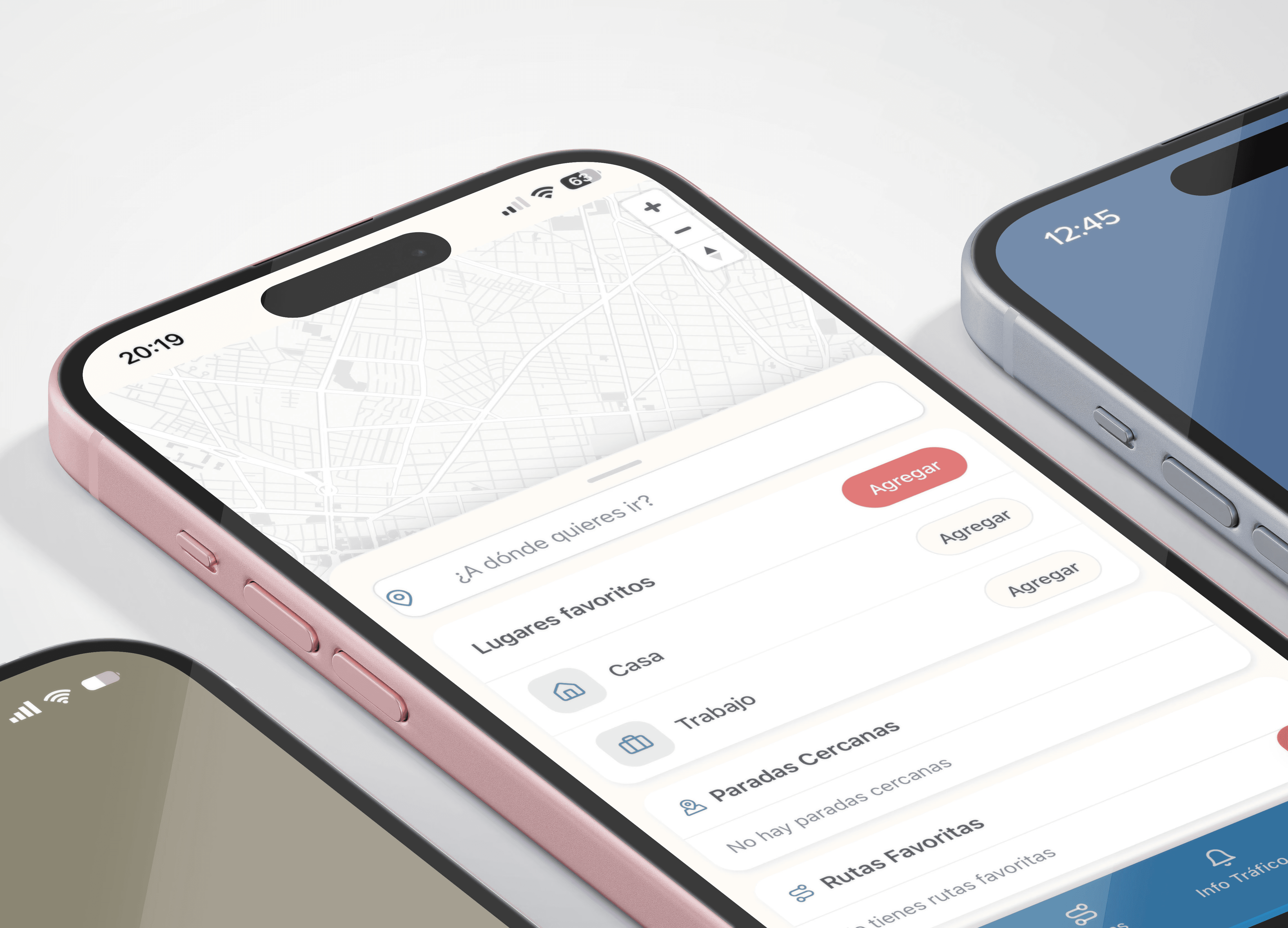
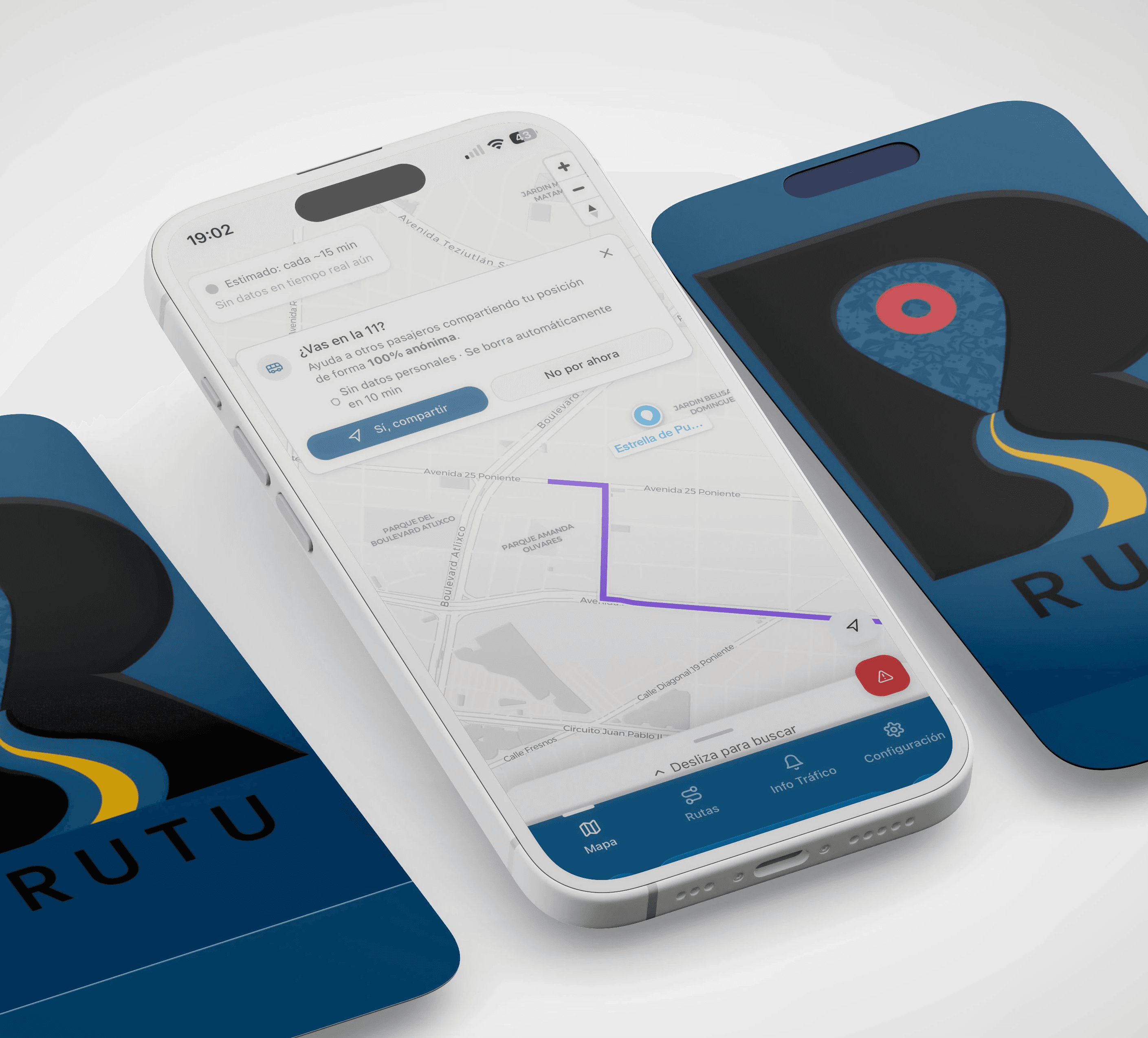
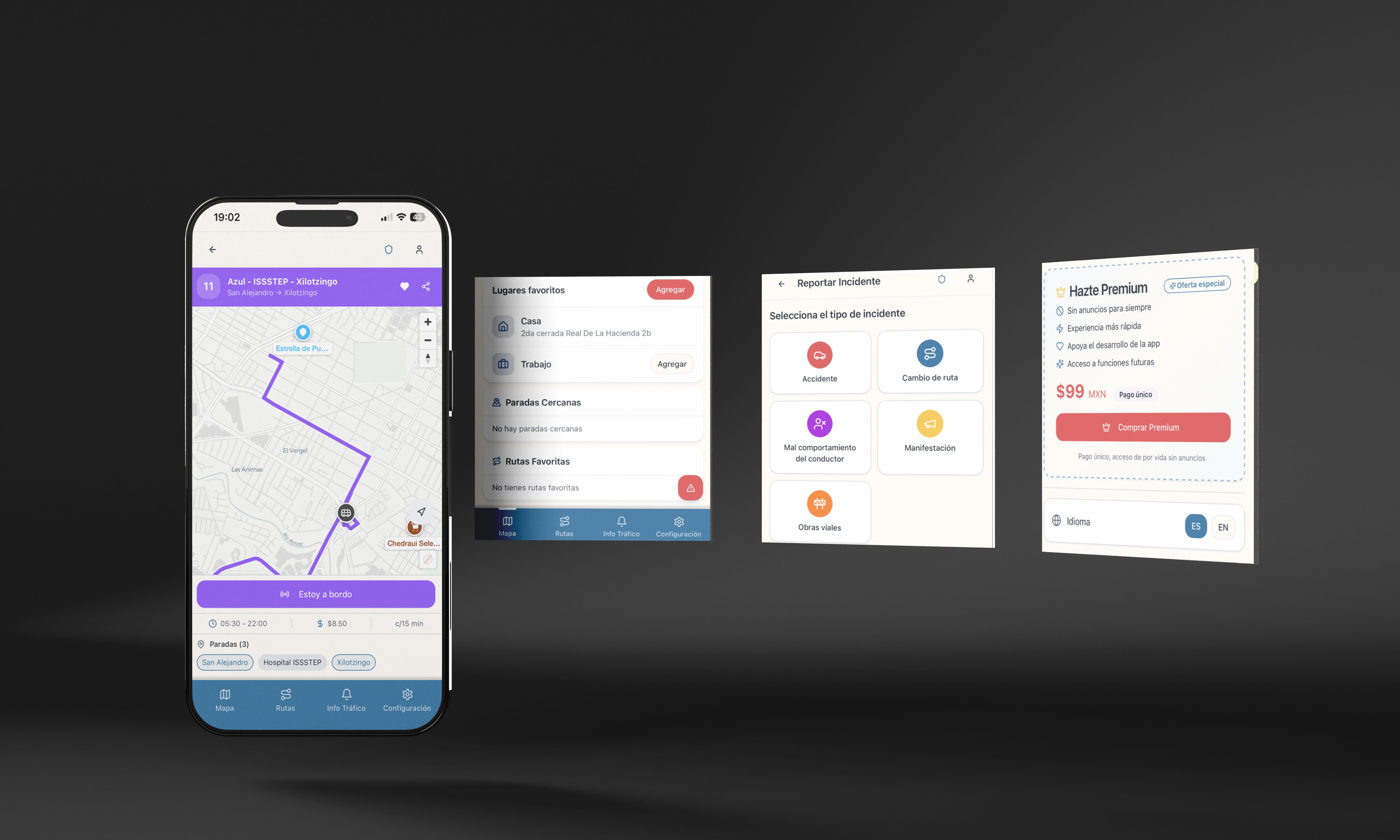
Key Features:
The "Easy-Path" Algorithm: An interface designed for clarity.
Security Sync: Real-time location sharing and "Follow My Ride" features, allowing to send ETA and live.
Favorites: Save you favorites places and routes so you ont waste time searching.
Challenge :
Humanizing the Data
The biggest hurdle wasn't the technology, but the User-Centered Design. AI can build a list, but it can’t feel the anxiety of a user standing on a street corner at 9:00 PM.
I had to ensure the UI felt "human." This meant designing high-contrast elements for outdoor visibility, large touch targets for users on a moving bus, and a "report"button for the security features that is accessible within a single thumb-reach. I didn't just let the AI build; I steered the AI to meet specific accessibility standards and cultural nuances specific to Puebla.
Summary :
RUTU stands as a proof of concept for how modern design workflows can integrate emerging technologies to solve deep-rooted civic issues. By blending User-Centered Design (UCD) with AI-assisted development, I was able to transition from identifying a complex urban pain point to delivering a functional, high-fidelity solution.
Key Takeaways from the Process:
Strategic Efficiency: Leveraging AI for the structural "heavy lifting" allowed me to dedicate more time to UX strategy.
Systemic Problem Solving: The project was driven by an analysis of "urban friction" in Puebla.
Technological Adaptability: Building RUTU required mastering a new suite of AI-powered tools on the fly.
More Projects

UI / UX Design
RUTU App
In a world where AI is often seen as a shortcut, I chose to use it as a force multiplier. As a designer, my goal is to solve real-world problems with speed and precision. RUTU is a mobile solution designed to facilitate the complex public transport network in Puebla, Mexico.
Year :
2025
Industry :
App/Mobility
Client :
Personal Project
Project Duration :
12 weeks
Problem :
Public transport users in Puebla often struggle to identify the correct bus routes because information about lines and schedules is incomplete, fragmented, or inaccurate. Existing tools such as Google Maps do not include all available bus lines, making it difficult—especially for newcomers like students and tourists—to navigate the city efficiently.
User Pain Points
🚏 Incomplete information: Many bus routes are missing from digital maps.
⏱️ Unreliable schedules: Public transport times are inconsistent or inaccurate.
🧭 Local knowledge required: New residents and visitors don’t know which buses to take.
🔍 Difficult route discovery: Users must rely on asking locals or trial-and-error.
Solution :
Navigating public transport in Puebla can be confusing—especially for newcomers who don’t know which bus to take or where to find reliable information. To understand this challenge, I followed a user-centered design process, starting with interviews and observations of students, tourists, and occasional riders trying to reach their destinations. The research revealed a system that relies heavily on local knowledge and incomplete tools like Google Maps. Using these insights, I created user personas to guide ideation, prototyping, and iterative testing, shaping a solution focused on one goal: helping anyone quickly discover the right bus line—even on their first day in the city.
Key Features:
The "Easy-Path" Algorithm: An interface designed for clarity.
Security Sync: Real-time location sharing and "Follow My Ride" features, allowing to send ETA and live.
Favorites: Save you favorites places and routes so you ont waste time searching.
Challenge :
Humanizing the Data
The biggest hurdle wasn't the technology, but the User-Centered Design. AI can build a list, but it can’t feel the anxiety of a user standing on a street corner at 9:00 PM.
I had to ensure the UI felt "human." This meant designing high-contrast elements for outdoor visibility, large touch targets for users on a moving bus, and a "report"button for the security features that is accessible within a single thumb-reach. I didn't just let the AI build; I steered the AI to meet specific accessibility standards and cultural nuances specific to Puebla.
Summary :
RUTU stands as a proof of concept for how modern design workflows can integrate emerging technologies to solve deep-rooted civic issues. By blending User-Centered Design (UCD) with AI-assisted development, I was able to transition from identifying a complex urban pain point to delivering a functional, high-fidelity solution.
Key Takeaways from the Process:
Strategic Efficiency: Leveraging AI for the structural "heavy lifting" allowed me to dedicate more time to UX strategy.
Systemic Problem Solving: The project was driven by an analysis of "urban friction" in Puebla.
Technological Adaptability: Building RUTU required mastering a new suite of AI-powered tools on the fly.
More Projects
UI / UX Design
RUTU App
In a world where AI is often seen as a shortcut, I chose to use it as a force multiplier. As a designer, my goal is to solve real-world problems with speed and precision. RUTU is a mobile solution designed to facilitate the complex public transport network in Puebla, Mexico.
Year :
2025
Industry :
App/Mobility
Client :
Personal Project
Project Duration :
12 weeks
Problem :
Public transport users in Puebla often struggle to identify the correct bus routes because information about lines and schedules is incomplete, fragmented, or inaccurate. Existing tools such as Google Maps do not include all available bus lines, making it difficult—especially for newcomers like students and tourists—to navigate the city efficiently.
User Pain Points
🚏 Incomplete information: Many bus routes are missing from digital maps.
⏱️ Unreliable schedules: Public transport times are inconsistent or inaccurate.
🧭 Local knowledge required: New residents and visitors don’t know which buses to take.
🔍 Difficult route discovery: Users must rely on asking locals or trial-and-error.
Solution :
Navigating public transport in Puebla can be confusing—especially for newcomers who don’t know which bus to take or where to find reliable information. To understand this challenge, I followed a user-centered design process, starting with interviews and observations of students, tourists, and occasional riders trying to reach their destinations. The research revealed a system that relies heavily on local knowledge and incomplete tools like Google Maps. Using these insights, I created user personas to guide ideation, prototyping, and iterative testing, shaping a solution focused on one goal: helping anyone quickly discover the right bus line—even on their first day in the city.
Key Features:
The "Easy-Path" Algorithm: An interface designed for clarity.
Security Sync: Real-time location sharing and "Follow My Ride" features, allowing to send ETA and live.
Favorites: Save you favorites places and routes so you ont waste time searching.
Challenge :
Humanizing the Data
The biggest hurdle wasn't the technology, but the User-Centered Design. AI can build a list, but it can’t feel the anxiety of a user standing on a street corner at 9:00 PM.
I had to ensure the UI felt "human." This meant designing high-contrast elements for outdoor visibility, large touch targets for users on a moving bus, and a "report"button for the security features that is accessible within a single thumb-reach. I didn't just let the AI build; I steered the AI to meet specific accessibility standards and cultural nuances specific to Puebla.
Summary :
RUTU stands as a proof of concept for how modern design workflows can integrate emerging technologies to solve deep-rooted civic issues. By blending User-Centered Design (UCD) with AI-assisted development, I was able to transition from identifying a complex urban pain point to delivering a functional, high-fidelity solution.
Key Takeaways from the Process:
Strategic Efficiency: Leveraging AI for the structural "heavy lifting" allowed me to dedicate more time to UX strategy.
Systemic Problem Solving: The project was driven by an analysis of "urban friction" in Puebla.
Technological Adaptability: Building RUTU required mastering a new suite of AI-powered tools on the fly.